
The History
The city of Akron was by a wilderness in the early 1800’s. The entrance of the rubber, grain, and machine manufacturing industry was years in the future.
The First United Methodist Church of Akron began in 1830 (5 years after the founding of the city), when a Sunday school class consisting of two teachers and nine scholars was organized and what was then called “South Akron“. In 1836, a 40‘x 50‘church building was erected at the corner of Broadway and Church streets to house the growing congregation.
On March 17, 1841, the original structure was destroyed in a fire caused by an overheated stove, and a new structure was built on the same foundation. Though this church was expanded in 1860, by 1866 it was determined that a larger church would soon be needed.
At that time, Lewis Miller, a local industrialist and inventor, was the director of the First Methodist Sunday school. Lewis Miller, the father-in-law of Thomas a Edison, was also the cofounder of Chautauqua in 1873. Miller saw this rebuilding as an opportunity to create a Sunday school space unlike anything ever used before, and keeping with his vision of the Sunday school as a lively and enjoyable center of Christian growth. With the help of Jacob Schneider, a local architect, Miller led the design of the new church. Construction began in 1867, and a new building was dedicated on January 21, 1872.
The main feature of the building was a large open space surrounded by smaller classrooms on two different levels. One wall of each class was movable, and opened onto the central auditorium. This allowed all the classes to join and combined opening and closing exercises while giving them privacy during their separate class times. In addition, another large movable wall could open the Sunday school auditorium onto the sanctuary, providing for extra seating during worship. The Design came to be called the Akron Plan, and was later copied in various forms by thousands of churches from the 1870s through the first World War.
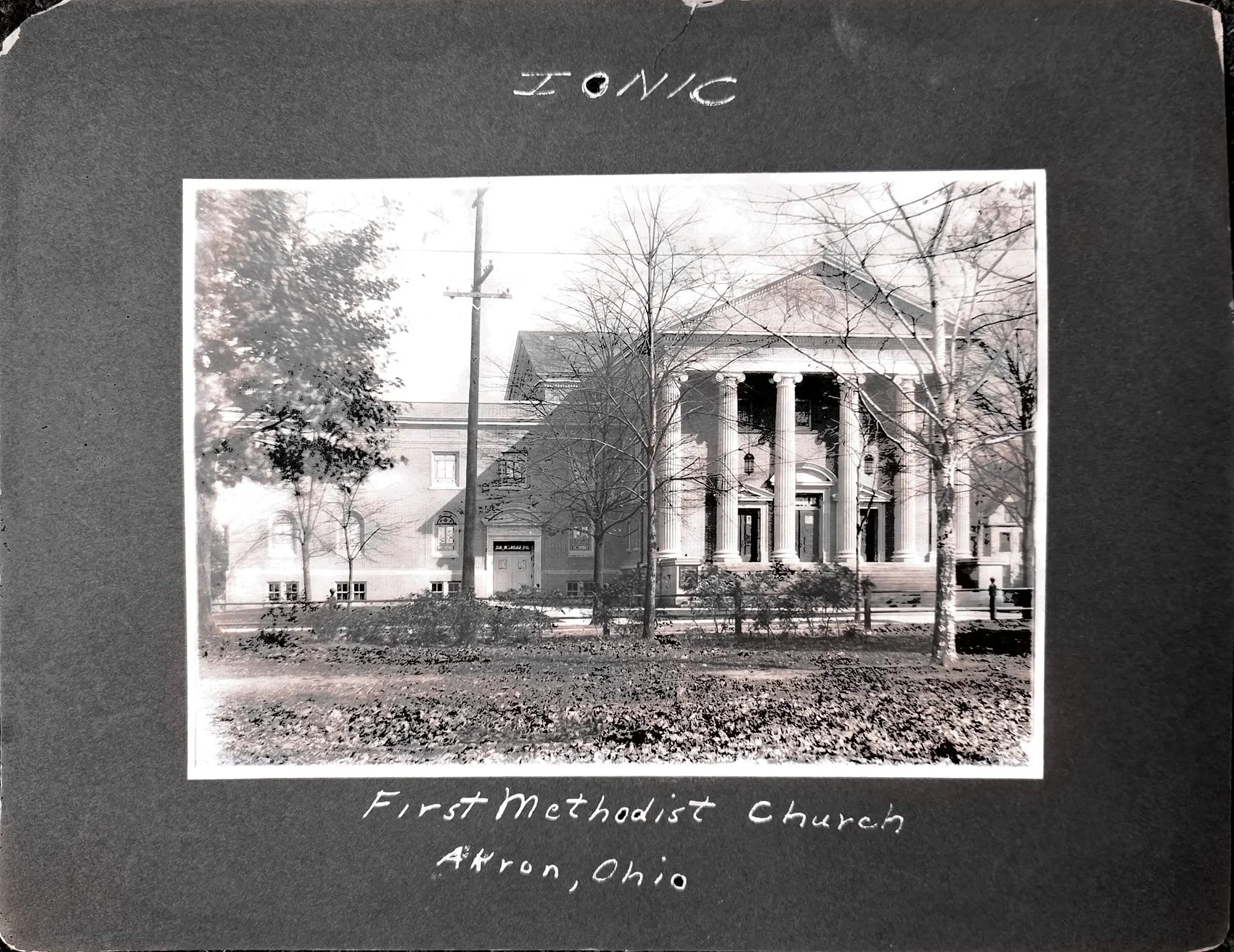
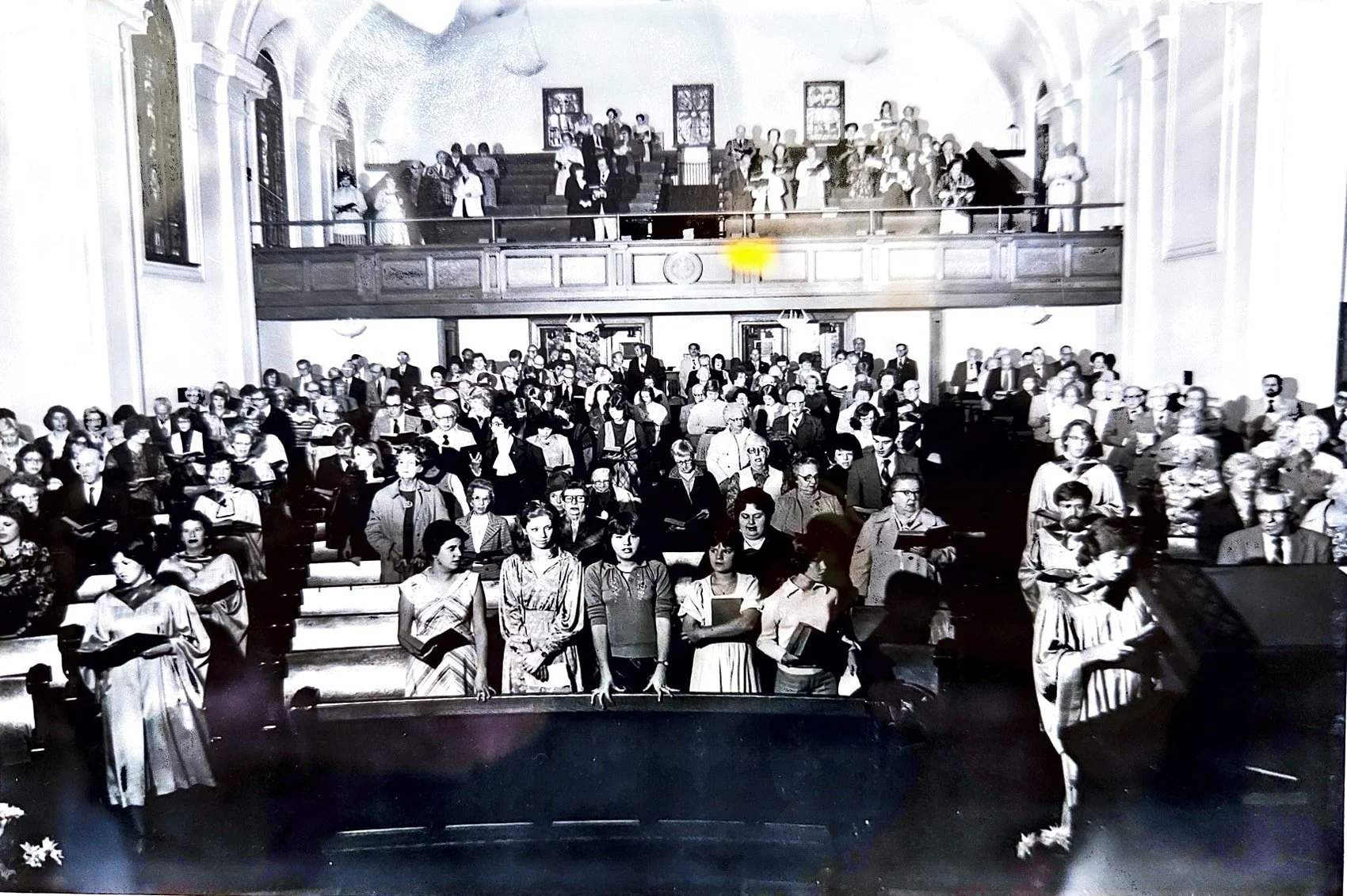
Thirty-nine years later tragedy struck again on August 30, 1911, when tinners soldering the roof of the church ignited a blaze that virtually destroyed the building. To make up for a severe short fall in insurance, the congregation sold the church site to the city of Akron as the location of a new armory. A new church site was selected at 263 East Mill Street. Construction of a Greek revival building based on a modification of the Akron Plan was begun on June 30, 1913, dedicated on October 25, 1914 at a total construction cost of $172,924. Architect member Milton Harpster employed Gothic windows and Greek columns to accent a magnificent structure within the growing heart of the prosperous city of Akron.
On April 29, 1994 an electrical short in the sanctuary brought a third visit of fire to the congregation and the 1914 building was destroyed. After a period of self-study, the congregation voted unanimously to reaffirm their identity as a downtown congregation and to rebuild on the same site. A building committee was selected, Braun and Stahl were chosen as architects, and the construction manager contract was awarded to Welty Building Corporation.
The new structure is a harmonious blend of contemporary and traditional architecture. Towering white pillars dominate the exterior of red brick, and a stately steeple topped by 15-foot cross rises 138 feet into the Akron skyline. The hexagonal sanctuary is warmly illuminated by the natural light from two dozen large windows. The pews curve over 180°, and though the sanctuary seats up to 500, no seat is more than 54 feet from the pulpit. An overflow seating area and reception hall named in memory of Lis Miller adjoins the rear of the sanctuary as a carryover from the Akron Plan auditorium and provides additional seating for up to 80.
Other features of the building are a large social hall with a complete stage, a small prayer chapel and a wide variety of Sunday school rooms that were closely integrated into the worship life of the congregation. The congregation of First United Methodist was proud to have the opportunity to build on the heritage of their past, and looks forward to many years of service in this latest manifestation of this church home.